Avalonfinance combines Bitcoin-backed credit with isolated lending markets
updatedAvalonfinance is a Bitcoin-focused lending ecosystem, presented under the Avalon Labs name, combining collateral-backed credit with isolated on-chain lending markets. Its products have included USDa, a Bitcoin-backed stablecoin. Avalon Labs announced USDa's discontinuation across supported chains in October 2026, alongside a separate Zeta Market sunset.
Bitcoin collateral and institutional credit
Bitcoin collateral supports Avalon's CeDeFi credit, giving borrowers stablecoin liquidity while their pledged assets secure the debt. CeDeFi combines centralized financial providers with decentralized finance infrastructure. Institutional lenders supply borrowing capital, and the credit arrangement uses fixed interest terms. The CeDeFi rate model adds Avalon's service spread to the institutional lender's rate.
The institutional credit offering places collateral with independent third-party custodians. Borrowers therefore need to distinguish the party holding collateral from the provider advancing stablecoins. An on-chain record doesn't mean the borrower retains unrestricted wallet control over pledged assets.
Avalon's institutional presentation emphasizes access by application. Its broader CeDeFi documentation also describes retail participation, so the institutional offering shouldn't define every user's eligibility. The relevant distinction is the particular credit arrangement, including its custody terms and collateral requirements.
Asset-specific on-chain lending pools
Isolated lending pools separate asset groups and apply risk parameters suited to their collateral. Avalon's design includes BTC liquid staking derivative pools, pools for tokenized real-world assets and general lending pools. A liquid staking derivative represents a staking position through a token, with its own market value. Each BTC liquid staking derivative has a dedicated pool containing the derivative and BTC. Stablecoin inclusion depends on that derivative's on-chain liquidity. General pools accommodate assets such as BTC, ETH and stablecoins, without making every asset available in every market.
Pool utilization measures how much available capital borrowers use. Avalon's variable-rate model raises borrowing rates as liquidity becomes scarce, with a steeper increase above a configured optimal utilization level. CeDeFi's fixed borrowing rates don't respond to pool utilization. Pool isolation limits shared exposure between asset groups; it doesn't remove the price risk of collateral inside an individual pool.
What changed for USDa holders in October 2026?
Avalon Labs announced USDa's discontinuation across all supported chains on October 3, 2026, and instructed holders to redeem their balances. USDa had connected Bitcoin collateral with stablecoin issuance through a collateralized debt position, or CDP. USDaLend used that stablecoin for lending and borrowing.
The notice required holders to submit a claim and complete withdrawal into supported assets by October 10, 2026, UTC. For USDa holdings unredeemed by that deadline, the notice specified a monthly custodial fee of 5% of the total remaining balance. That charge continues until redemption completes.
The stated deadline has passed. Users with unresolved balances can raise a support ticket through Avalon Labs' Discord.
The announced Zeta Market asset return
Avalon announced a separate return plan for Zeta Market, under which Avalon would value net positions in USD and distribute corresponding USDT on Ethereum. The October 3, 2026 notice connected the market sunset to ZetaChain's infrastructure transition. Eligibility depended on the Ethereum address associated with the user's ZetaChain address.
| Announced return stage | Avalon's responsibility and asset destination |
|---|---|
| Unified position snapshot | Avalon would record user positions across Zeta Market. |
| Net position calculation | Avalon would calculate each user's net position from the snapshot. |
| USD valuation | Avalon would value each net position in USD at the snapshot time. |
| Verification | Avalon would handle verification before distribution. |
| Distribution on Ethereum | Avalon would send corresponding USDT to the eligible Ethereum address associated with the user's ZetaChain address. |
| This process required a claim containing the user's ZetaChain address by October 17, 2026, UTC. | |
The claim date has passed. The announced return plan doesn't establish whether a particular address has received its distribution.
Oracle-dependent markets and withdrawal access
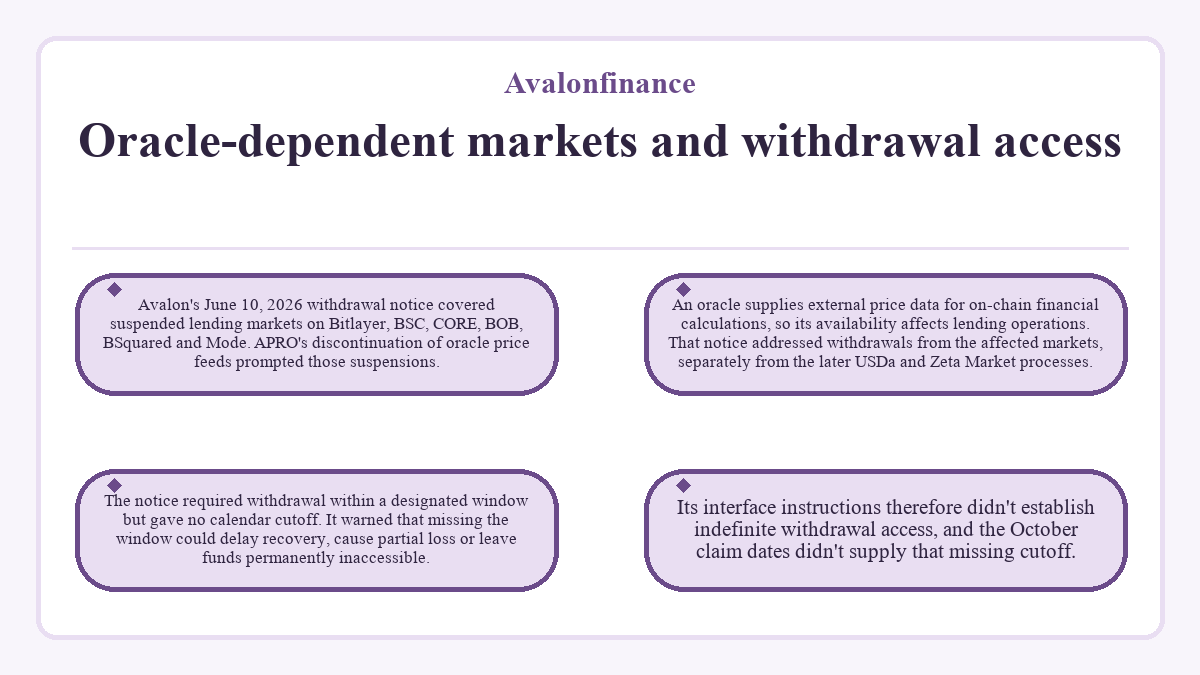
Avalon's June 10, 2026 withdrawal notice covered suspended lending markets on Bitlayer, BSC, CORE, BOB, BSquared and Mode. APRO's discontinuation of oracle price feeds prompted those suspensions. An oracle supplies external price data for on-chain financial calculations, so its availability affects lending operations. That notice addressed withdrawals from the affected markets, separately from the later USDa and Zeta Market processes. The notice required withdrawal within a designated window but gave no calendar cutoff. It warned that missing the window could delay recovery, cause partial loss or leave funds permanently inaccessible. Its interface instructions therefore didn't establish indefinite withdrawal access, and the October claim dates didn't supply that missing cutoff.
Collateral values and liquidation exposure
Loan-to-value, or LTV, compares borrowed value with collateral value; a fixed borrowing rate doesn't freeze either asset's market price. Price changes can alter collateral coverage even when the agreed rate stays constant.
Borrowing and liquidation limits
Opening a loan
Maximum LTV limits how much debt an eligible collateral position can support when borrowing. The liquidation threshold governs a later deterioration in collateral coverage. These parameters answer different questions, and neither one describes the loan's interest rate.
Crossing the liquidation threshold
CeDeFi risk rules describe collateral liquidation when LTV exceeds the applicable threshold, with a recovery LTV as the target afterward. The DeFi lending mechanism uses a health factor, a measure of collateral coverage. A health factor below 1 makes the loan eligible for liquidation. Asset-specific parameters determine the relevant exposure; one product's threshold shouldn't substitute for another's.
Yield accounts and Super Earn
Avalon presents Super Earn as a token-earning offering alongside its borrowing and lending products. Its displayed APY, meaning annual percentage yield, describes an earning opportunity rather than the cost of a collateral-backed loan. A target APY expresses a yield objective; it doesn't establish the return a particular deposit has already earned. Earlier USDa materials also described yield-bearing arrangements, including sUSDa. Those historical yield statements don't restore USDa's pre-discontinuation status or establish current earning terms. Each earning product retains its own asset, availability and return conditions.
What do the audit and custody arrangements cover?
Smart-contract audits address protocol code, while third-party custody arrangements address how institutional collateral is held. Avalon lists Salus, SlowMist, BlockSec and Nethermind among its contract reviewers.
Avalon also describes continuous on-chain monitoring and response procedures. These measures address technical operation and incident detection. They don't eliminate price-driven liquidation exposure or establish uninterrupted market availability after an oracle provider stops service.
Product access and the lending timeline
Avalon's product entry points distinguish on-chain lending, CeDeFi credit, USDa and Super Earn. The June 2026 lending guide asks users to connect the wallet holding their positions; institutional credit uses a separate access application. Those entry paths reflect different custody and access arrangements. The March 6, 2025 roadmap also included future USDa payment use through an Avalon Credit Card. Avalon Labs' March 2025 retrospective placed its Bitcoin-focused DeFi lending launch in March 2024 and USDa's launch in November 2024.
Avalonfinance - common questions
Can a smart contract wallet receive a Zeta Market distribution?
Smart contract wallets, multisig wallets and exchange deposit addresses may need special handling because Ethereum compatibility isn't automatic. The October 3, 2026 notice instructed users with those address types to contact the Avalon Labs team before submitting any claim form. An address associated with a position doesn't by itself establish compatible access on Ethereum.
What happens if a claim includes incorrect information?
Incorrect or unverifiable claim information can delay processing, and completed distributions cannot be reversed. Users are responsible for submitting complete, accurate information. The asset-adjustment notice warns that submissions the team can't verify may require additional review, so submitting a form doesn't establish that a claim has passed verification.
Will Avalon Labs ask for payment to release claimed assets?
Avalon Labs states it won't request private keys, seed phrases or payment as part of the asset-adjustment claim process. A request for any of those items conflicts with the stated claim instructions.
Why did an older bookmark stop opening the lending platform?
Avalon separated USDa and DeFi Lending entry points in its May 23, 2025 URL update. The older shared application entry points ceased serving lending features under that change. This navigation change preceded the later USDa discontinuation announcement and didn't mean every Avalon product had ended.
Where does a supplier's lending yield come from?
Borrowers' interest funds DeFi supplier yield after a reserve-factor share goes to the ecosystem reserve. Utilization affects the interest yield shared among all suppliers; the documented average supply APY also includes flash-loan fees. The supply APY can therefore differ from the borrow rate for the same market, and it isn't a fixed payment promised to every supplier.
Why is the market's total supplied amount different from my position?
A market's total supplied amount measures the market, while Your Info displays the connected wallet's own position. Avalon separates market-wide statistics from personal supplied amounts, borrowed amounts and available actions. The selected network and asset determine which position the interface displays.
Can I withdraw collateral during a CeDeFi liquidation?
Avalon's CeDeFi liquidation rules temporarily prevent collateral withdrawals until the liquidation process completes. The process also updates the account's collateral and loan amounts afterward.
How long did Avalon estimate affected-market withdrawals would take?
Avalon's June 10, 2026 guide described a withdrawal taking less than two minutes, with assets returning after on-chain confirmation. That timing statement concerned the affected lending markets listed in the guide. It didn't establish processing times for the separate October USDa claims or Zeta Market asset returns.