Avalonfinance allows partial CeDeFi repayment while full collateral withdrawal requires settling the debt
updatedAvalonfinance allows partial repayment of its CeDeFi loans during the loan term, while full collateral withdrawal requires settling principal and interest. A smaller payment leaves an outstanding loan and collateral requirements. Reducing the debt and requesting the release of pledged assets serve different purposes within the same borrowing arrangement.
Repayment flexibility within an existing CeDeFi loan
CeDeFi borrowing connects decentralized finance infrastructure with centralized lending capital. Partial repayment lets a borrower reduce an existing obligation during its term. The repayment terms allow any amount up to the full debt, including principal and interest. Principal is the amount borrowed; interest is the borrowing charge. Paying down debt can leave collateral pledged against the remaining balance. Recovering some collateral adds a withdrawal condition, while recovering all of it requires complete repayment. Permission to repay during the term doesn't establish an interest calculation method or promise a fee waiver.
The terms governing a first adjustment
An outstanding CeDeFi loan provides the starting point for an adjustment. Before submitting a repayment, decide whether the task ends with debt reduction or also includes collateral recovery. You can stop after this review without changing the loan. If you proceed, repay part of the debt during the loan term and check that the remaining loan balance reflects the payment.
| Parameter | Documented terms | Required loan or collateral state |
|---|---|---|
| Repayment amount | Any amount up to the full principal and interest | An outstanding CeDeFi stablecoin loan |
| Repayment window | At any time during the loan term | The loan remains within its term |
| Partial collateral withdrawal | The withdrawn amount must comply with LTV requirements | Sufficient collateral remains for the debt |
| Full collateral withdrawal | Repay all principal and interest first | The entire borrowed amount, including interest, is repaid |
| Collateral claim timing | Claimable within 1-2 business days of initiating a withdrawal request | A collateral withdrawal request has been initiated |
| Loan claim asset | USDT | Approval of the requested loan |
| Further borrowing requests | Multiple requests are possible within the required LTV | Deposited collateral supports the resulting borrowing |
The timing attached to a collateral claim starts with its withdrawal request. It doesn't describe how quickly a repayment changes the debt balance.
Partial payments and the remaining collateral ratio
Loan-to-value, or LTV, compares the loan's value with the collateral's value. With collateral value unchanged, reducing the loan balance lowers this ratio.
A collateral withdrawal changes the other side of that relationship. Removing pledged assets reduces the collateral supporting any debt still outstanding.
Consequently, a partial payment doesn't establish an automatic right to withdraw a matching quantity of collateral. The remaining position must satisfy the applicable LTV requirements.
A USDT payment and a quantity of FBTC collateral have different units, so their amounts aren't interchangeable. A smaller debt can create more room under a borrowing limit; removing collateral raises LTV again if the remaining debt stays unchanged. Neither relationship establishes the amount of collateral a particular loan permits the borrower to withdraw.
Full collateral release after principal and interest repayment
Full withdrawal of CeDeFi collateral requires repayment of the entire borrowed amount, including principal and interest. Paying back only the original principal doesn't satisfy that condition if interest remains due. Complete repayment establishes the debt condition for a full withdrawal; the documented collateral process also includes a withdrawal request followed by a claim. A borrower seeking only a smaller debt can stop short of requesting collateral release.
Collateral claim timing after a request
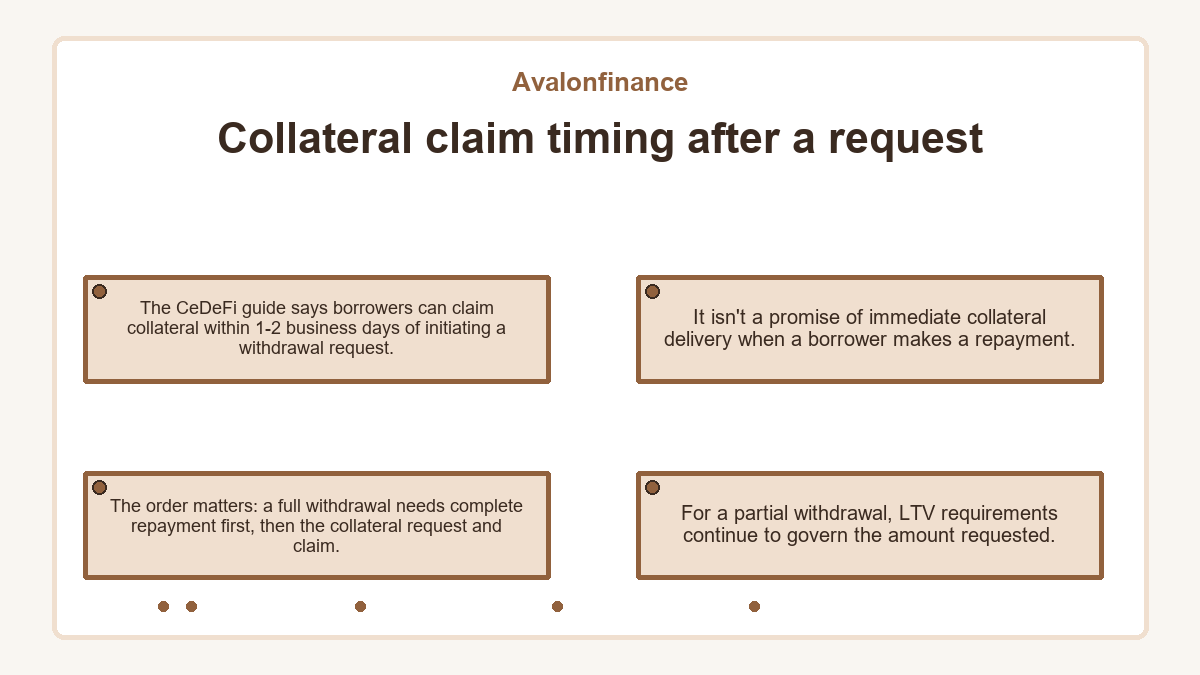
The CeDeFi guide says borrowers can claim collateral within 1-2 business days of initiating a withdrawal request. It isn't a promise of immediate collateral delivery when a borrower makes a repayment.
The order matters: a full withdrawal needs complete repayment first, then the collateral request and claim. For a partial withdrawal, LTV requirements continue to govern the amount requested.
Further borrowing within the required LTV
Additional CeDeFi borrowing requests remain possible when the deposited collateral supports the required LTV.
More borrowing increases the loan value relative to unchanged collateral. A previously compliant position therefore doesn't establish the permitted size of a later request. Each request must fit the applicable LTV, and the borrower claims the USDT loan after approval. A repayment alone isn't approval for additional credit.
USDT loans and separate asset withdrawal routes
The CeDeFi borrowing process identifies USDT as its loan asset. USDa was a separate Bitcoin-backed stablecoin. Avalon Labs announced its discontinuation across supported chains in Important Notice Regarding Recent Asset Adjustments, published October 3, 2026. That notice required USDa holders to submit a claim form and complete withdrawal by October 10, 2026 UTC. It specified a custodial fee of 5% of the total remaining balance per month for holdings unredeemed by that deadline, until redemption is complete. That date doesn't establish the repayment deadline for a CeDeFi USDT loan.
On-chain lending withdrawals also use a different process. Avalon Labs' June 10, 2026 instructions for suspended lending markets describe selecting the network and asset before opening Details and Your Info. Those controls concern the affected market position. They don't establish CeDeFi repayment controls or replace its collateral request and claim process. The intended adjustment must follow the product holding the loan or asset.
What readers ask about Avalonfinance
-
Does a partial CeDeFi payment go to interest before principal?
- The CeDeFi repayment terms cover principal and interest without specifying how a partial payment divides between them. A reduction in the total balance shouldn't be treated as proof of an equal reduction in principal.
-
How long does claiming a newly approved CeDeFi loan take?
- The documented CeDeFi process gives a typical loan-claim period of 1-2 business days after approval. It identifies USDT as the asset to claim. Depositing collateral or requesting a loan doesn't establish an immediate payout; approval precedes the loan claim.
-
Can I pledge FBTC for a CeDeFi loan with partial repayments?
- The documented CeDeFi borrowing process supports FBTC collateral and permits partial repayments during the loan term. FBTC secures the borrowing, while the loan claim is in USDT. Releasing all collateral still requires settling the entire borrowed amount, including principal and interest.
-
What happens if collateral loses value after a partial repayment?
- A fall in collateral value can raise LTV again, even after debt falls. CeDeFi liquidates a portion of collateral when LTV exceeds its liquidation threshold. A previous partial repayment doesn't freeze collateral value or ensure the remaining position stays below that threshold.
-
Where does pledged Bitcoin stay during an institutional CeDeFi loan?
- Avalon's institutional CeDeFi credit offering describes Bitcoin collateral held by independent third-party custodians. A repayment changes the debt obligation; it doesn't itself transfer that collateral to the borrower. The collateral withdrawal process still governs release, including complete debt repayment for a full withdrawal.
-
Is the advertised CeDeFi borrowing rate monthly or annual?
- The institutional CeDeFi credit offer quotes a 7% annual borrowing rate and a six-month fixed loan term. That quote alone doesn't specify the interest calculation for a partial repayment. The amount due for a loan must include principal and interest under its actual terms.