Avalonfinance USDa combined Bitcoin-backed borrowing with USDT conversion before its announced wind-down
updatedAvalonfinance USDa was Avalon Labs' stablecoin, issued through Bitcoin-backed borrowing or a separate USDT minting route. Its collateralized debt position design linked loan issuance, collateral requirements and stablecoin conversion. On October 3, 2026, Avalon Labs announced discontinuation across all supported chains. The notice set October 10, 2026 UTC as the deadline for claim submission and withdrawal, with a 5% monthly custodial fee on remaining unredeemed balances until redemption completion.
The October 2026 discontinuation notice
Avalon Labs announced USDa's discontinuation across all supported chains in its October 3, 2026 notice, Important Notice Regarding Recent Asset Adjustments. The announcement reported unauthorized extraction of USDa liquidity through on-chain mechanisms. Avalon presented discontinuation as its response after exhausting other remediation options. That scope covered the stablecoin across supported chains, beyond an individual lending market.
The wind-down changed the immediate task for existing holders. The notice called for conversion back to supported assets through a claim process, while older material still described ordinary minting and savings. Those operating-era descriptions explain the design. They don't confirm that minting or savings deposits remained available under the wind-down terms. The stated USDa deadline has passed, and the notice didn't give a separate timetable for late claims.
How did Bitcoin collateral produce USDa?
Bitcoin collateral supported a USDa loan through Avalon's collateralized debt position, so borrowing created a stablecoin balance alongside an obligation secured by pledged assets. CeDeFi combined decentralized finance infrastructure with centralized liquidity providers. A collateralized debt position, or CDP, connected the borrowing obligation to its collateral. The USDa instructions identified FBTC as supported collateral for this route.
The loan-to-value ratio, or LTV, compared borrowed stablecoin value with collateral value. This relationship determined the borrowing amount the collateral could support. Borrowing preserved exposure to the pledged Bitcoin asset while adding debt and collateral requirements.
The separate USDT minting route
USDT deposits provided another documented way to obtain USDa: the operating-era instructions specified one USDa for each USDT deposited through Avalon CeDeFi. This route converted an existing stablecoin holding into USDa without opening the FBTC-backed loan described above.
A USDa balance therefore didn't reveal its acquisition route. Its holder could have borrowed against FBTC, deposited USDT or bought USDa through a supported decentralized exchange. These paths produced ownership of the same stablecoin through different arrangements. Responsibility for an originating loan remained a separate question. A claim concerning a token holding couldn't, by itself, establish the settlement of an associated borrowing obligation.
Did holding USDa automatically earn the savings yield?
Holding USDa alone didn't establish a savings position; the documented savings arrangement gave depositors sUSDa, a yield-bearing version of the stablecoin. The design linked savings income to USDa borrowing charges and revenue from USDaLend. Ordinary USDa and the savings token consequently represented different holdings, even though the savings arrangement used USDa as its underlying asset. The historical instructions required a seven-day cooldown to unstake sUSDa and described DEX conversion as an alternative. The discontinuation notice didn't confirm continued access to either route.
A historical savings rate described income for the savings token. It didn't specify the charge on a USDa loan or replace the redemption terms after discontinuation.
Fixed borrowing costs and changing collateral values
USDa's borrowing model kept its rate independent of utilization, while collateral requirements continued to depend on the value securing each outstanding loan. Utilization measures how much available lending capital borrowers have drawn. Separating the borrowing rate from that measure made the quoted borrowing cost predictable within the documented rate model. It didn't freeze collateral prices or eliminate liquidation exposure. Falling collateral value could raise a loan's LTV without any additional borrowing.
Avalon's CDP risk design distinguished the liquidation threshold from the recovery LTV liquidation aimed to restore. Those parameters concerned collateral-backed debt and the sale of collateral. They didn't define the wind-down fee.
What balance did the 5% monthly fee cover?
The October 3, 2026 USDa wind-down notice set a 5% monthly custodial fee on total remaining balances unredeemed after October 10, 2026 UTC until redemption completion.
The same notice said Avalon wouldn't ask for a private key, seed phrase or payment as part of the claim process.
The custodial fee differed from the original borrowing charge and from a savings return. Moving tokens between addresses wouldn't, by itself, demonstrate that Avalon had completed a redemption or assessed a custodial charge.
The notice didn't specify a daily accrual formula, a partial-month rule or the first billing date. Dividing 5% by an assumed number of days would introduce an extra billing assumption. A charge calculation therefore needed the applicable remaining balance and assessment period; elapsed calendar days alone didn't establish an amount actually charged.
A monthly fee calculation on an unredeemed balance
A hypothetical remaining balance of 12,743 USDa produces a fee equivalent to 637.15 USDa for one applicable monthly assessment under the 5% rule. The arithmetic is
12,743 × 0.05 = 637.15
. This calculation uses the remaining unredeemed balance as its input, so it doesn't calculate a percentage of past profits or the original amount acquired.
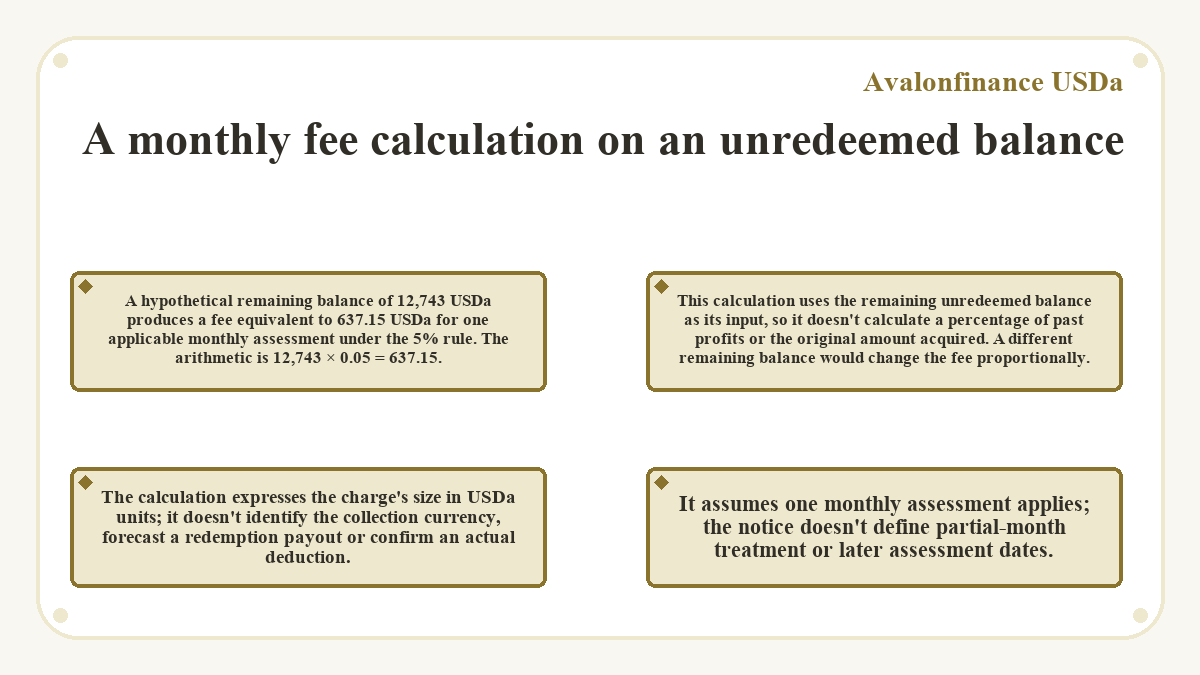
A different remaining balance would change the fee proportionally. The calculation expresses the charge's size in USDa units; it doesn't identify the collection currency, forecast a redemption payout or confirm an actual deduction. It assumes one monthly assessment applies; the notice doesn't define partial-month treatment or later assessment dates.
Redemption and collateral release
USDa's operating-era conversion route specified one USDT per USDa through a conversion vault on Ethereum mainnet, while collateral release remained part of the borrowing arrangement. The conversion instructions required USDa to reach Ethereum before vault deposit and described claiming USDT in one business day. Those were normal conversion terms. The wind-down notice introduced a claim process without carrying that completion estimate forward.
Collateral recovery addressed a different obligation. The lending rules required repayment of principal and interest before full collateral withdrawal. Repayment settled debt secured by pledged assets; conversion exchanged the USDa holding for USDT. The wind-down claim terms didn't state that returning USDa also automatically closed a loan or released collateral.
The boundary with the Zeta Market asset return
USDa redemption and the Zeta Market asset return had separate terms within the same October 3, 2026 announcement. The Zeta plan used a snapshot to value each user's net market position in USD. Avalon planned the corresponding distribution in USDT on Ethereum to an eligible associated address, with a separate October 17, 2026 UTC claim deadline. Those settlement details concerned the Zeta Market return. They didn't establish a universal USDT-on-Ethereum payout rule for every USDa claim. The later Zeta deadline didn't extend the USDa deadline.
A first review before claim submission
A first review of an existing USDa holding can stop at recording its network, remaining balance and holding form, without submitting a claim or changing the position. Distinguishing ordinary USDa from a savings position or an outstanding loan helps identify which relationship needs resolution. The past minting route explains the position's origin; the wind-down terms govern the redemption question.
Claim submission and redemption completion represented different states. Submission concerned the holder's information, while completion concerned the return of supported assets. Avalon required complete, accurate claim details and warned that unverifiable submissions could require additional review and delay processing. That made accurate balance and address information relevant before submission, without establishing a fixed processing time.
You can correct details during a balance review, but the notice stated that processed transfers couldn't be reversed.
Key questions about Avalonfinance USDa
-
When did Avalon first deploy USDa?
- Avalon Labs placed USDa's deployment in November 2024 in its March 6, 2025 retrospective. That event followed the launch of its Bitcoin-focused lending market in March 2024. The two dates described different product milestones, so the earlier lending launch shouldn't serve as USDa's launch date.
-
Was the historical 15% savings figure USDa's borrowing rate?
- The 15% APY figure in Avalon Labs' March 6, 2025 retrospective concerned sUSDa holders. It described savings income, while a USDa borrowing rate described the cost of debt. The figures concerned different positions and calculation bases. That historical savings figure didn't establish an ongoing yield entitlement after the USDa discontinuation announcement.
-
Who supplied USDT behind USDa's original conversion design?
- Centralized finance liquidity providers supplied the USDT in USDa's original conversion design. Avalon described USDa as a loan token within its CeDeFi infrastructure, connecting token conversion with those providers. An on-chain token operation could therefore depend on centralized liquidity.
-
Can a smart contract wallet receive a USDa wind-down distribution?
- Smart contract wallets required contact with Avalon Labs before claim submission because Ethereum compatibility couldn't be assumed. The October 3, 2026 notice warned that smart contract wallets, multisig wallets and exchange deposit addresses might lack Ethereum accessibility or compatibility. That warning didn't specify Ethereum as the settlement network for every USDa claim.
-
Did USDa's 1:1 conversion promise fix its exchange trading price?
- The historical 1:1 term covered conversion from USDa to USDT through Avalon's specified arrangement. It didn't set the execution price of every decentralized exchange trade. A trading price also depended on the chosen market's available liquidity. After the discontinuation announcement, the old conversion term couldn't establish a current executable sale price or guarantee the outcome of a wind-down claim.