Avalonfinance liquidation sells CeDeFi collateral when LTV exceeds the liquidation threshold
updatedAvalonfinance liquidation sells part of a CeDeFi borrower's collateral when loan-to-value exceeds the liquidation threshold. The process aims to reduce LTV by adjusting the loan and pledged assets. The applicable collateral parameters determine eligibility, while the account's balances show the position remaining after execution.
Account figures before the trigger
A loan record connects the borrowed stablecoin value with the value of pledged collateral. LTV expresses that relationship as a percentage. The figures need to concern the same position and valuation point; mixing an earlier debt value with a later collateral value changes what the calculation describes.
Borrowed stablecoin value
Borrowed stablecoin value forms the numerator, so a higher borrowed value raises LTV if collateral value stays unchanged. The relevant amount belongs to the loan record, so a token balance in a wallet doesn't establish how much debt remains.
Pledged collateral value
Collateral value forms the denominator, so falling collateral value raises LTV even without further borrowing. Holding the same collateral quantity therefore doesn't preserve the same borrowing ratio.
When does a CeDeFi position become eligible for liquidation?
A CeDeFi position becomes eligible when its LTV exceeds the liquidation threshold applicable to its collateral. The FBTC CeDeFi parameter set for USDT borrowing lists a maximum borrowing LTV of 60%. That FBTC configuration has a liquidation threshold of 90% LTV. Its recovery LTV is 80%, the target ratio after liquidation.
The borrowing ceiling limits how much credit the collateral can support when borrowing. A position can exceed that ceiling before reaching the liquidation threshold. The recovery target describes the remaining loan relative to collateral; it isn't the percentage of collateral the process sells. These values concern the documented FBTC CeDeFi configuration.
Collateral restrictions and execution
Temporary withdrawal restriction
CeDeFi liquidation temporarily blocks collateral withdrawals until the process finishes.
Collateral sale
Avalon sells collateral on centralized exchanges. Its high-frequency trading algorithm collects order-book data and adjusts execution aggressiveness to market conditions. The method aims to limit slippage and market impact; an account valuation isn't a fixed execution price.
Account update
Avalon updates the collateral and loan amounts after liquidation. Those changes describe the remaining position, while a price crossing alone doesn't establish a completed sale.
An LTV change without further borrowing
Could an existing FBTC-backed USDT loan cross its liquidation threshold without another loan? Consider these hypothetical loan values in USD: borrowed stablecoin value = 8,184, collateral value before repricing = 14,640 and collateral value after repricing = 8,880. Only the collateral valuation changes in this example.
Using
LTV = borrowed_value / collateral_value * 100
, the first reading is
8,184 / 14,640 * 100 = 55.90%
. After repricing, it becomes
8,184 / 8,880 * 100 = 92.16%
. The unchanged borrowed value now represents a larger share of collateral value.
The second reading exceeds the FBTC configuration's 90% threshold and establishes liquidation eligibility under that parameter set. It doesn't establish that execution has occurred or calculate the eventual sale amount. A different debt value, collateral valuation or applicable threshold would change the conclusion.
Intervention while the loan remains open
CeDeFi permits repayments during the loan term, including partial payments up to the full obligation of principal and interest. Reducing the borrowed amount lowers LTV when collateral value remains unchanged. That relationship explains how repayment can change exposure before an event, without promising time to intervene after the trigger.
Reviewing the loan and collateral figures leaves the position untouched; you can stop there without submitting a repayment. Any resulting debt reduction needs to appear in the loan record before it can explain a lower LTV. A collateral price move can offset an earlier improvement, so a previously lower ratio doesn't establish the account's later condition.
What changes for suspended or discontinued positions?
A suspended or discontinued product requires its own withdrawal or recovery process, even if a position appears healthy. Avalon Labs published withdrawal instructions on June 10, 2026 for lending markets it had suspended after APRO discontinued oracle services. The affected markets were on Bitlayer, BSC, CORE, BOB, BSquared and Mode. The notice warned that missing its designated withdrawal window could delay recovery or cause partial loss or permanent inaccessibility.
Avalon Labs announced USDa's discontinuation across all supported chains on October 3, 2026, alongside a separate Zeta Market sunset. The notice required USDa claim submission and withdrawal by October 10, 2026 UTC. It specified a monthly custodial fee of 5% of the remaining unredeemed USDa balance after that deadline until redemption completes. Zeta Market claims had a separate October 17, 2026 UTC submission deadline. They don't establish that every CeDeFi loan ended, and an LTV calculation alone can't resolve a discontinued product's recovery requirements.
The separate on-chain liquidation boundary
Avalon's on-chain DeFi lending uses a health factor below 1 as its liquidation trigger. This is a separate risk model from CeDeFi's collateral-specific LTV thresholds.
In the documented DeFi model, a liquidator repays up to 50% of a borrower's debt. The collateral deduction covers that repayment plus an asset-specific liquidation bonus for the liquidator. Those repayment and bonus rules shouldn't become assumptions about a CeDeFi collateral sale.
Loan reconciliation after the event
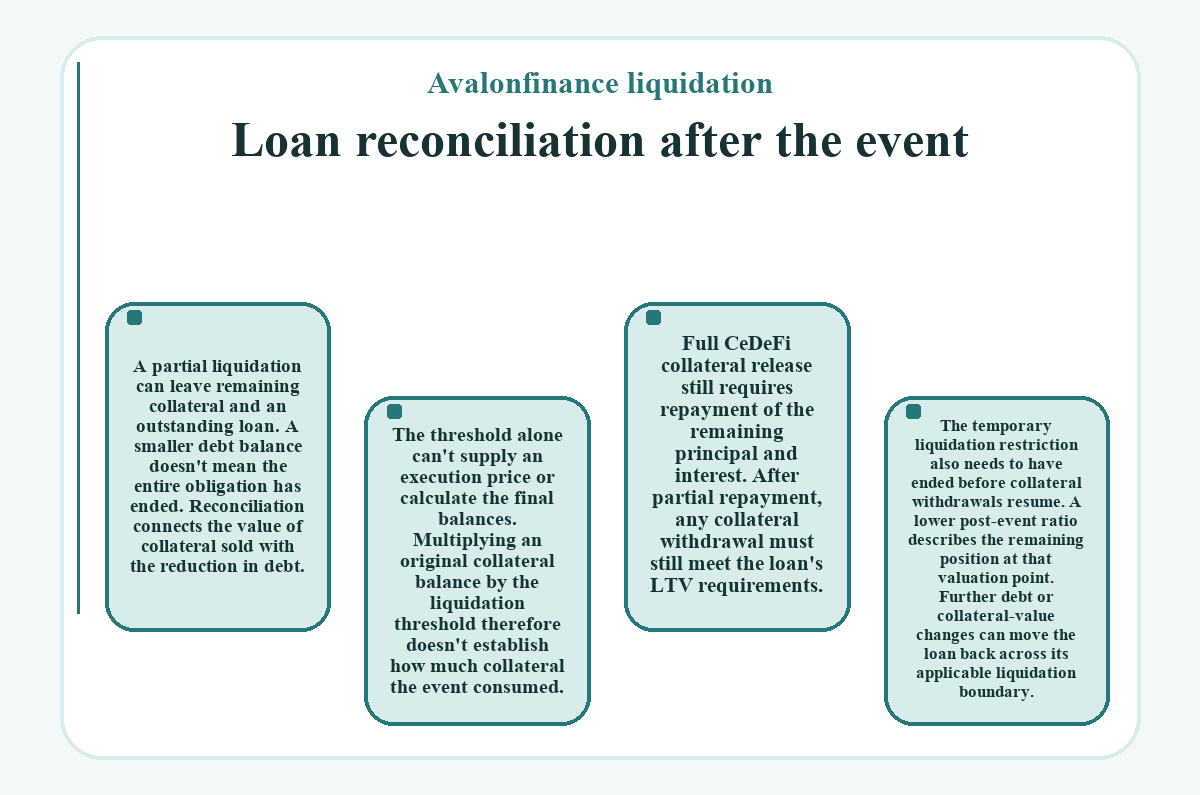
A partial liquidation can leave remaining collateral and an outstanding loan. A smaller debt balance doesn't mean the entire obligation has ended.
Reconciliation connects the value of collateral sold with the reduction in debt. The threshold alone can't supply an execution price or calculate the final balances. Multiplying an original collateral balance by the liquidation threshold therefore doesn't establish how much collateral the event consumed.
Full CeDeFi collateral release still requires repayment of the remaining principal and interest. After partial repayment, any collateral withdrawal must still meet the loan's LTV requirements. The temporary liquidation restriction also needs to have ended before collateral withdrawals resume.
A lower post-event ratio describes the remaining position at that valuation point. Further debt or collateral-value changes can move the loan back across its applicable liquidation boundary.
Avalonfinance liquidation: the short answers
Does a fixed CeDeFi borrowing rate prevent liquidation?
A fixed borrowing rate doesn't fix the value of pledged collateral. CeDeFi liquidation follows the loan's applicable LTV threshold. Borrowing costs can remain predictable while collateral repricing changes the ratio between the loan and its backing.
Is the DeFi 50% repayment limit half of my collateral?
The documented DeFi limit concerns debt repayment, while the collateral deduction also covers the applicable liquidation bonus. A 50% debt repayment doesn't establish a 50% reduction in collateral quantity.
Can stablecoin repricing affect an on-chain loan's health factor?
A fall in a stablecoin's value can lower an on-chain loan's health factor when that stablecoin serves as collateral. The effect depends on the repriced asset's role in the position.
Does the CeDeFi collateral-claim timeframe provide time to stop liquidation?
The collateral-claim timeframe doesn't establish a liquidation waiting period. The CeDeFi withdrawal instructions describe claiming collateral within 1-2 business days after initiating a withdrawal request. Liquidation follows a separate LTV condition and temporarily restricts collateral withdrawal until that process finishes.
Could withdrawing collateral increase a CeDeFi loan's liquidation exposure?
Withdrawing collateral raises LTV if the borrowed value remains unchanged. CeDeFi withdrawal amounts must comply with the loan's LTV requirements. A withdrawal therefore changes the denominator of the ratio, even when the borrower hasn't increased the outstanding loan.
Who can carry out an Avalon DeFi liquidation?
Avalon's DeFi liquidation mechanism allows open participation by liquidators. Automated tools compete for liquidation bonuses in this on-chain process.